
A Reason to Gather: Social Infrastructure and Rural Revitalization in North Montpelier, Vermont
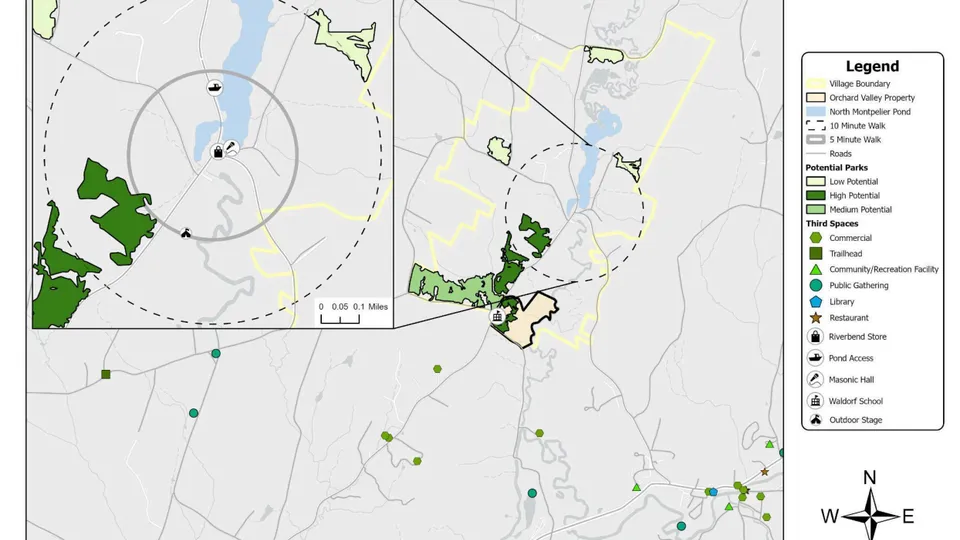
North Montpelier was once a self-sufficient village with mills, an organ factory, and a cultural life that drew visitors from across the region. Today, its historic buildings stand vacant, its median age has climbed from 26.9 in 1970 to 47.1, and — as one resident put it at this year’s town meeting — many people in the surrounding area don’t even know where it is.
For his senior capstone at Brown University, East Montpelier resident Tommy Barton spent a year researching what it would take to reverse that trajectory and create a village that young people deliberately choose. Drawing on surveys with East Montpelier residents and Brown University students, case studies of comparable communities like Hardwick and Skowhegan, and GIS spatial mapping of the village, his research concludes that the most powerful first step isn’t a master plan or a major capital investment — it’s giving people a reason to gather.
Third places: a revived concert series, a cleared skating pond, a workshop in a yurt, a lit bridge in December. These are the conditions under which housing development, economic investment, and newcomer integration all become possible. The full report, including spatial analysis, community survey findings, and a phased set of recommendations for the Town Manager, is linked below.
Systems maps
The research includes two causal loop diagrams (CLDs) exploring the feedback loops behind village decline and revitalization — explore them interactively below.
Main CLD — the full system of feedback loops connecting population, housing, economic activity, and civic life in North Montpelier.
Third Space CLD — a focused view on how social infrastructure (gathering spaces, recurring events, informal meeting places) drives the rest of the system.